
Happy New Year everyone! I hope you had wonderful time with family and friends over the holidays.
This month I want to share a diagnostic breakthrough I had with a client team that was stuck. They knew problem-solving was too slow, they knew their people were frustrated, but they couldn’t figure out exactly what was blocking them.
After spending three days at the Gemba (Japanese term for where the work gets done) interviewing leaders and watching teams work, I saw the pattern. The manufacturing director said: “People don’t know what to prioritize.” The quality director said: “Everything requires three approvals.” The project manager said: “Nobody knows who can actually make decisions.”
Different symptoms. Same root cause? Not quite. They had all three types of barriers blocking problem-solving at once.
Theory
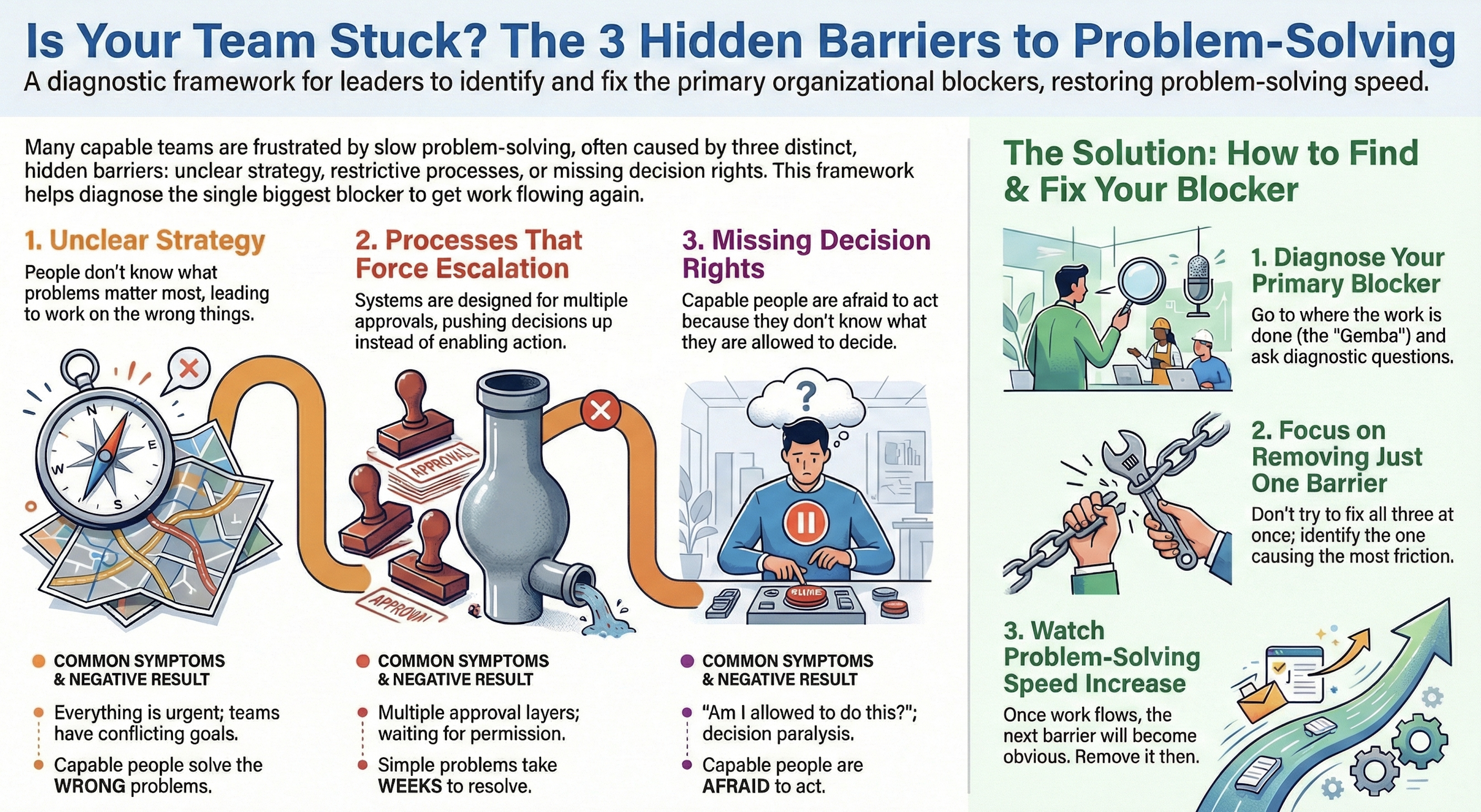
Over the years, I’ve noticed that what blocks problem-solving always falls into one of three categories:
1. Unclear Strategy – People don’t know what problems matter most
- Symptoms: Everything is urgent, nothing gets prioritized, teams work on different goals
- The result: Capable people solving the wrong problems efficiently
2. Processes That Force Escalation – Systems designed to push decisions up, not enable action
- Symptoms: Multiple approval layers, “that’s how we’ve always done it,” waiting for permission
- The result: Problems that could be solved in hours take weeks to work up and back down
3. Missing Decision Rights – Nobody knows who can decide what without approval
- Symptoms: “I don’t know if I’m allowed to,” frequent check-ins for permission, decision paralysis
- The result: Capable people afraid to act, even when they know the solution
Most organizations have all three, but usually one is the primary blocker. Fix that one first, and problem-solving starts to flow.
My thoughts
What fascinated me about this client was watching their “ah-ha” moment when we mapped which barrier was causing which symptom.
The manufacturing director realized his team wasn’t struggling with unclear priorities – they actually knew what mattered. They were struggling with unclear decision rights. They knew WHAT to do but not IF they were allowed to do it.
The quality team had the opposite problem – they had clear decision rights for their work, but the process itself forced escalation at multiple checkpoints “just to be safe.” The system blocked them, not the authority.
And the project managers? They genuinely didn’t know what problems to prioritize because strategic alignment was unclear at the leadership level.
Same symptom (slow problem-solving), three different root causes.
Here’s what I’ve learned: you can’t remove barriers you can’t see. And you can’t see barriers from a conference room. You have to go to the Gemba, watch the work flow (or not flow), and listen to what people say about why. Using the diagnostic questions below helped this team quickly identify which barrier was their primary blocker. Within two weeks of removing it, problem-solving speed increased dramatically.
How to
Want to diagnose which barrier is blocking your team? Ask these questions:
Is it UNCLEAR STRATEGY?
- Do different teams prioritize different goals?
- When you ask “what’s most important right now,” do you get different answers?
- Are people working on problems that don’t align with strategic objectives?
Is it PROCESSES THAT FORCE ESCALATION?
- Do routine decisions require multiple approval layers?
- Is your process designed around “checking” rather than “enabling”?
- Do people say “that’s just how we do it” when you ask why something needs approval?
Is it MISSING DECISION RIGHTS?
- Do people frequently ask “am I allowed to decide this?”
- Is there confusion about who can make which decisions?
- Do people escalate because they’re unsure of their authority, not their capability?
The pattern of “yes” answers will show you where to focus first.
Call to action!
This January, diagnose which barrier is your primary blocker. Use the questions above with your team. Don’t try to fix all three at once – identify the one that’s causing the most friction and remove it first.
Once work starts flowing there, the next barrier will become obvious.
Let’s start 2026 by removing what’s in the way!
Want to catch up on any newsletters you may have missed? Check them out here.
Enjoying this newsletter? Share it!
Received this email from a friend or want to learn more?
Click the link below to visit our website, sign up, or book a meeting.
www.elisharpconsulting.com
Eli Sharp.
