
This month I want to share something that happened recently that reminded me why I do this work.
I received a call from a client I worked with 18 months ago. My heart sank a little – was I about to hear that everything we built together had fallen apart?
Instead, she said: “I wanted to tell you what’s still working. And why.”
That conversation taught me something important about what sustainability actually looks like.
Theory
Most organizations measure sustainability by asking: “Are we still following the process we created?”
That’s the wrong question.
The right question is: “Are we still solving problems the way we learned to solve them together?”
Here’s why that distinction matters:
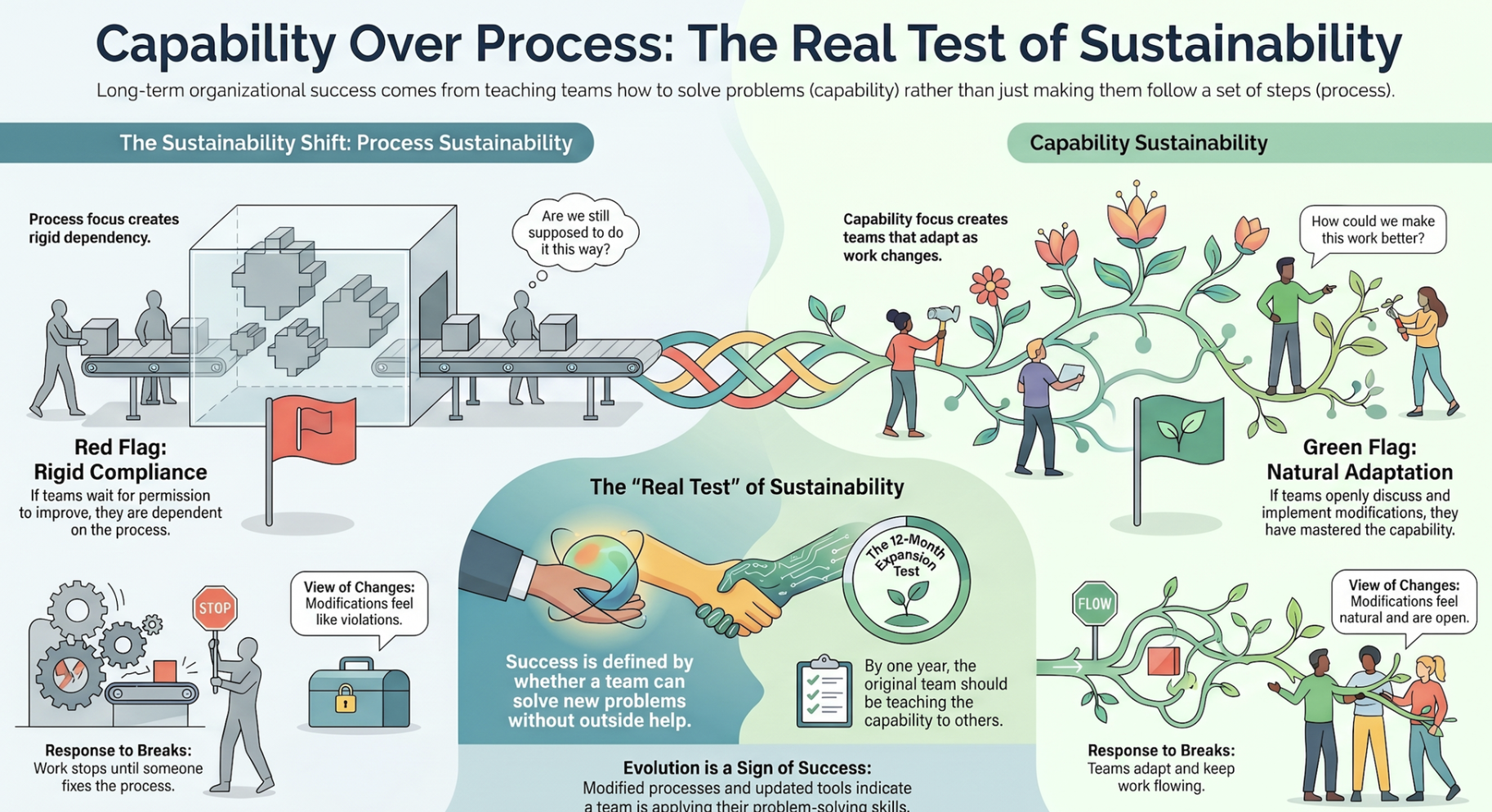
Process sustainability (the wrong focus):
- Are people following the steps?
- Are they using the templates?
- Are they maintaining the documentation?
- Result: Compliance that feels like a burden
Capability sustainability (the right focus):
- Are people identifying problems quickly?
- Are they solving them collaboratively?
- Are they improving their own processes?
- Result: Problem-solving that feels natural
Processes need to evolve. Capability doesn’t disappear.
When you focus on sustaining the process, you create dependency on the process. When you focus on sustaining the capability, you create teams that adapt their processes as work changes.
My thoughts
My client told me what was still working 18 months later. Here’s what surprised me:
The specific process we created together? They’d modified it three times based on what they learned. That wasn’t failure – that was success. They were using their problem-solving capability to improve their problem-solving process.
The brown paper process map we created? Long gone – replaced by a digital version that better fits their needs. Again, success. They weren’t preserving what we created – they were applying what they learned.
But here’s what hadn’t changed:
- How they collaborate: Still mapping problems together before solving them
- How they make decisions: Still using clear decision rights we established
- How they respond to issues: Still solving problems in days instead of weeks
- How they communicate: Still going to the Gemba when things aren’t clear
The specific outputs changed. The underlying capability remained.
That’s when I realized: sustainability isn’t about maintaining processes – it’s about maintaining the problem-solving capability that creates and improves those processes.
When consultants leave and everything falls apart, it’s because they built process dependency (or consultant dependency), not problem-solving capability. When consultants leave and things keep improving, it’s because they unleashed capability that continues to work.
How to
Want to check if you’re building sustainable capability (not just sustainable processes)? Look for these indicators:
Signs you’re building process dependency:
- People ask “are we still supposed to do it this way?”
- Modifications feel like violations
- If the process breaks, work stops until someone fixes it
- Teams wait for permission to improve
- People say “but this is the process we created”
Signs you’re building problem-solving capability:
- People ask “how could we make this work better?”
- Modifications feel natural and are discussed openly
- If the process breaks, teams adapt and keep flowing
- Teams improve without asking permission
- People say “here’s how we evolved what we learned”
To sustain capability after any change initiative:
- Check in at 3 months: What are they still doing? What have they modified? Why?
- Good sign: They modified something to fit their reality better
- Warning sign: They’re following exactly what you created (they’re dependent)
- Check in at 6 months: Have they solved new problems without you?
- Good sign: They tackled something you didn’t work on together
- Warning sign: They’re only maintaining what you created
- Check in at 12 months: What have they taught others?
- Good sign: They’re spreading the capability to new teams
- Warning sign: They haven’t expanded beyond the original group
The real test isn’t “did they keep doing what we created?”
The real test is: “Are they solving NEW problems in the way we learned to solve problems together?”
If yes, you built capability. If no, you built dependency.
Call to action!
This month, if you’ve implemented any improvement initiative in the past year, check your sustainability indicators. Are your teams maintaining processes or maintaining capability?
If they haven’t modified anything you created together, that’s not a good sign – it means they’re dependent on your design instead of using their own problem-solving capability.
Encourage them to improve what you built together. That’s when you know it’s really working.
Let’s build capability that outlasts us!
Want to catch up on any newsletters you may have missed? Check them out here.
Enjoying this newsletter? Share it!
Received this email from a friend or want to learn more?
Click the link here to visit our website, sign up, or book a meeting.
Eli Sharp.
