
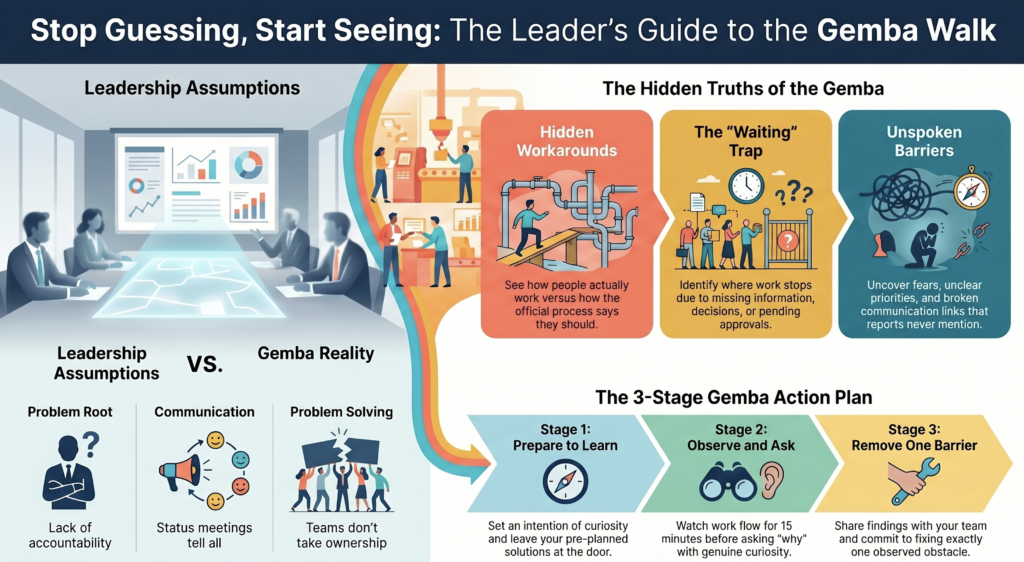
This month I want to share a story about what happens when leaders actually go to the Gemba – the Japanese term for “the real place” where work happens.
Recently I was working with a leadership team that was convinced their problem was “lack of accountability.” They’d spent months trying to fix it with new metrics, more frequent status meetings, and performance improvement plans.
I asked if I could spend a day on the floor talking to their teams. The executive sponsor hesitated: “What will that tell us that we don’t already know from our reports?”
Everything, as it turned out.
Theory
The Gemba reveals what conference rooms conceal. Reports tell you outcomes. The Gemba tells you why.
When you go to where the work actually happens and watch with curiosity instead of judgment, you see three things that are invisible from leadership meetings:
1. The workarounds – How people actually get work done vs. how the process says they should
- These workarounds exist for a reason
- They reveal where your process doesn’t match reality
- They show you what’s blocking the “official” way
2. The waiting – Where work stops flowing and why
- Not just waiting for materials or equipment
- Waiting for information, decisions, approvals, clarification
- This waiting is where problems could be getting solved but aren’t
3. The unspoken barriers – What people won’t say in meetings but will show you in practice
- Fear of speaking up
- Unclear priorities creating paralysis
- Missing tools or authority
- Broken communication links
You can’t remove barriers you can’t see. And you can’t see barriers from your office.
My thoughts
When I spent the day at the Gemba with this “accountability problem” team. Here’s what I actually found:
What leadership thought: “Our teams don’t take ownership of problems”
What I saw at the Gemba: Teams identifying problems constantly and telling me what the solutions were. When I asked why they were not telling their leaders about these problems and solutions, they said they tried that already. The problem was that they would propose solutions – then watch those solutions disappear into a black hole. After three months of this, they stopped proposing solutions.
The problem wasn’t accountability. The problem was that their accountability was being systematically extinguished by a system that didn’t respond.
When I reported back, the executive sponsor was stunned. “They never told us this in our status meetings.”
Of course they didn’t. People don’t tell you in meetings what they’ll show you at the Gemba. They tell you what they think you want to hear. They show you what actually happens.
Here’s what I’ve learned: the barriers blocking problem-solving are invisible from the conference room. You have to go to the Gemba with genuine curiosity – not to inspect or audit, but to understand.
That’s where the truth lives.
How to
Want to conduct your own Gemba walk to see what’s really blocking problem-solving? Here’s how:
Before you go:
- Set your intention: You’re there to learn, not to fix or judge
- Prepare questions that invite truth-telling:
- “Walk me through what happens when you identify a problem”
- “What gets in the way of solving it quickly?”
- “What would need to change to make your work flow better?”
- Leave your solutions at the door – you’re gathering data, not implementing
While you’re there:
- Watch first, ask second
- Observe the actual work for 15 minutes before asking anything
- Notice where work flows and where it stops
- Pay attention to workarounds
- Ask “why” with curiosity, not judgment
- “Help me understand why you do it this way”
- “What would happen if you tried X instead?”
- Listen for the barriers in their answers
- Look for the waiting
- Where do people stop working and start waiting?
- What are they waiting for?
- Who or what could remove that wait?
- Notice what’s NOT happening
- Are people solving problems or escalating them?
- Are people collaborating or working in silos?
- Are people acting or asking permission?
After you return:
- Resist the urge to immediately solve
- Share what you learned with your leadership team
- Ask “what does this tell us about our barriers?”
- Pick ONE barrier to remove based on what you saw
The Gemba doesn’t lie. Your reports might. Your meetings definitely do. But the Gemba shows you exactly what’s blocking work from flowing.
Call to action!
This month, schedule a Gemba walk. Block 3 hours (yes, really – 1 hour to observe, 2 hours to talk and listen). Go to where your team’s work actually happens. Watch. Ask. Listen.
See what’s invisible from your desk.
Then come back and remove one barrier. Just one. Watch what happens when you remove what you saw instead of what you assumed.
Let’s go to where the truth lives!
Want to catch up on any newsletters you may have missed? Check them out here.
Enjoying this newsletter? Share it!
Received this email from a friend or want to learn more?
Click the link here to visit our website, sign up, or book a meeting.
Eli Sharp.
